Cost per Yard Efficiency: How MJE Measures Cycle Time, Fuel, and Function
MJE is digging deeper to redefine efficiency in ag-industrial earthwork
When most folks think of dirt work, they think of brute force. Big iron. Bigger horsepower. But at MJE, we’re asking a smarter question: What’s the most cost-effective way to move a yard of dirt?
That’s the driver behind our latest internal production study—a real-world, boots-on-the-ground comparison of dozens of machines from CAT, Case IH, Volvo, Fendt, John Deere, and more. Yes, we’re watching load times. But more importantly, we’re tracking fuel burn, cycle time, and true cost per yard moved.
This isn’t just about speed. It’s about value.
Why This Study Matters to You
Whether you’re an engineer, feedyard manager, dairy operator, or biogas partner, the dirt has to move before your project gets off the ground. And moving it wrong costs you—in time, in fuel, and in dollars.
It’s not just about how fast you can move dirt, it’s about how smart you can move it. We’re running the numbers so we can back every bid with real-world data.
Ryan Asbridge, Equipment Fleet Manager, MJE, LLC
Here’s What We’re Breaking Down and Why:
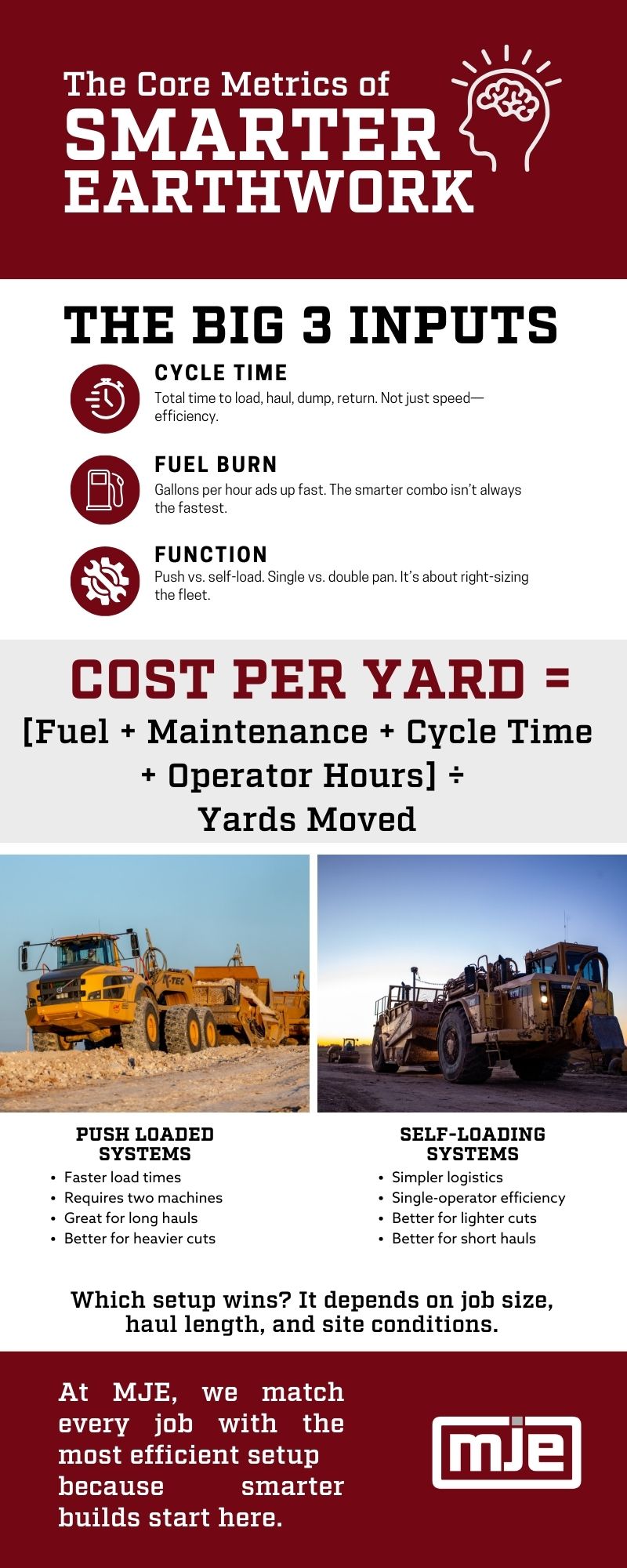
CYCLE TIME
What is it: the time it takes for a machine to load, haul, dump, and return.
Why it matters: Faster isn’t always better. A machine with a shorter cycle time might burn twice the fuel or cost more to maintain.
Who it helps: Project managers and estimators trying to forecast real timelines – not theoretical ones.
FUEL CONSUMPTION
What we’re watching: Gallons per hour across every power plant, from D10 dozers to Fendt tractors.
Why it matters: Fuel is one of the top recurring costs on any site. A machine that burns 8 GHP vs 39 GHP can flip your bid from profit to loss.
Who it helps: Budget-conscious owners and operators evaluating long-term ROI.
FUNCTION & FLEXIBILITY
What we’re comparing: Push-loaded pans vs self-loading scrapers, double pans vs. singles, tractors vs. trucks.
Why it matters: You don’t need the biggest tool. You need the right tool for the job. We’re studying real-world performance, not spec-sheet theory.
Who it helps: Engineers and owners deciding whether to scale with traditional methods or rethink the fleet.
What We’re Really After
You can’t manage what you don’t measure. That’s why we’re applying hard data—not gut feel—to answer one of the most important questions in earthmoving: Which setup moves the most dirt for the lowest total cost?
We’re tracking and comparing key performance inputs across real jobsite conditions, including:
Fuel consumption from onboard equipment monitoring platforms
Maintenance trends based on historical service and operational hours
Operator efficiency across standardized cycle zones
Load dynamics and slip rates under varying ground conditions
Our goal isn’t to pick a favorite machine. It’s to understand which configurations consistently deliver maximum output at the lowest cost per yard—so we can build smarter, bid sharper, and pass that value on to every client we serve.What’s emerging isn’t a “winner,” but a smarter strategy—knowing when and where to deploy certain equipment combinations to optimize total job cost, not just production rate.
“We’ve always known our crews could outwork the competition. Now we’re proving we can outthink them, too, right down to the fuel burn per yard.”
Aaron Jantz, CEO, MJE, LLC
For Our Partners and Clients: This is How We Bid Smarter
This study isn’t academic. It’s actionable. It helps us:
Sharpen bids in a competitive market by understanding our true operating costs
Cut waste—in fuel, time, and overbuilt equipment
Advise clients on the most efficient build paths, especially for dairies, feedyards, and large ag-industrial installations
If you’re investing millions into infrastructure, you deserve a contractor who knows what’s driving cost—not one who just guesses. At MJE, that’s what we’re building every day: Smarter by the Yard.
Want to See What We’re Tracking Next?
Subscribe to our email newsletter and follow along as we release key takeaways, equipment matchups, and real cost-per-yard insights in the coming weeks.
Newsletter Signup
Let’s Turn Some Dirt
Get construction’s brightest minds and hardest workers started on your next project.